Advanced Science: Volume 12, No. 38
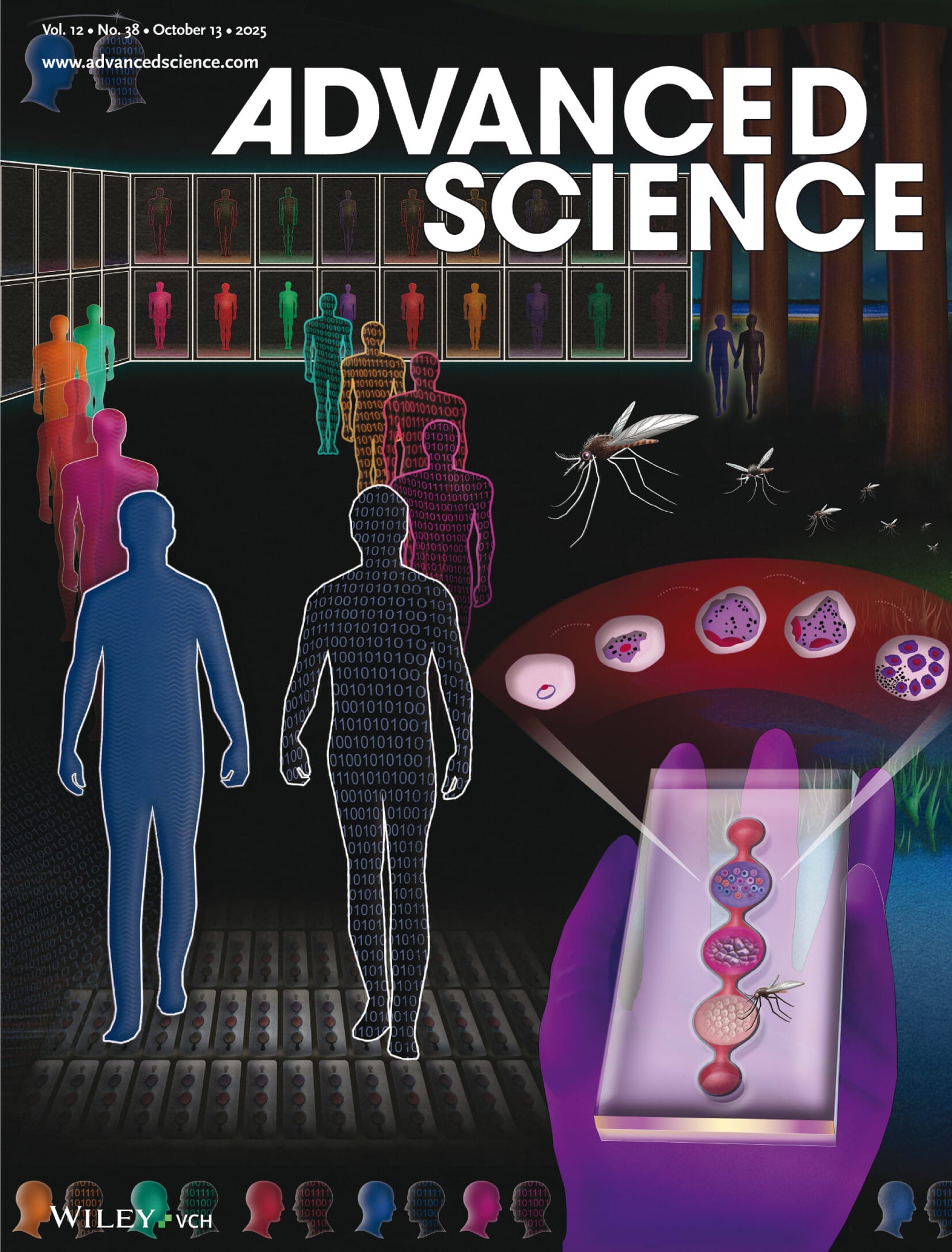
Advanced Science featured our publication “Translation of a Human-Based Malaria-on-a-Chip Phenotypic Disease Model for In Vivo Applications” as its cover article (Vol. 12, No. 38 October 13, 2025).
The cover artwork depicts our human-based Malaria-on-a-Chip platform that reproduced the complete lifecycle of the deadliest malaria parasite and demonstrated that existing (and new) malaria treatments could be tested in this system. Further, the data also produced what is believed to be the first Digital Medical Twin of a human disease generated by an organ-on-a-chip system.
Key Results from Study
- First Digital Medical Twin from Organ-on-a-Chip: Hesperos successfully created what's believed to be the first digital medical twin derived from an organ-on-a-chip system.
- Multi-Organ Human System: The study utilized a human-based multi-organ system comprised of human liver, spleen, endothelial tissue, and blood to accurately reproduce the full lifecycle and test treatments for Plasmodium falciparum (the malaria parasite).
- Predicting Human Drug Responses: By combining the data generated by the malaria-on-a-chip system with advanced, in silico, pharmacokinetic/pharmacodynamic (PK/PD) modeling, the study accurately predicted the clinical outcomes for multiple antimalarial agents.
Revisit Publication & Press Release
Revisit the publication and press release announcing this paper at the link below:
Hesperos Demonstrates First Digital Twin of Human Disease Using Organ-on-a-Chip Platform
Journal Cover
View the journal cover and Open-Access publication by clicking here.
“This study is a proof-of-concept that we can now generate and validate digital twins using entirely human-based, non-animal platforms - something regulatory agencies and drug developers have long envisioned.”
James J. Hickman, PhD
Chief Scientist
Discover how we can advance your pipeline faster and more efficiently
Explore Other Hesperos News
Hesperos and UCF Showcase First-of-its-Kind Human-on-a-Chip® Comorbidity Model to Accelerate Drug Discovery for Aging Populations
Hesperos and UCF publish new study in Alzheimer’s and Dementia demonstrating peripheral neuromuscular pathology is NOT CNS dependent in Alzheimer’s Disease
Advancing Human-Relevant Science: Hesperos Featured in ‘The New Gold Standard’ Documentary
The Hesperos team recently gathered for a private screening of the upcoming feature documentary, The New Gold Standard: Cutting Edge Science That’s Replacing Animal Testing. As pioneers in human-on-a-chip technology, our routine focus centers on the … Read More

Hesperos at Microphysiological Systems World Summit 2026
Join Hesperos at the 2026 MPS World Summit in Washington, DC If you are attending the MPS World Summit (Washington, DC, 26 – 29 May 2026), please stop by Booth 523 to learn more about how … Read More